 Sealwell Siding Services
Trim and Soffit Replacement Peoria
Peoria County's climate puts trim and soffit under stress that most homeowners only notice after the damage is already deep. Winter temperatures regularly drop below 10 °F, and the freeze-thaw cycle that runs from…
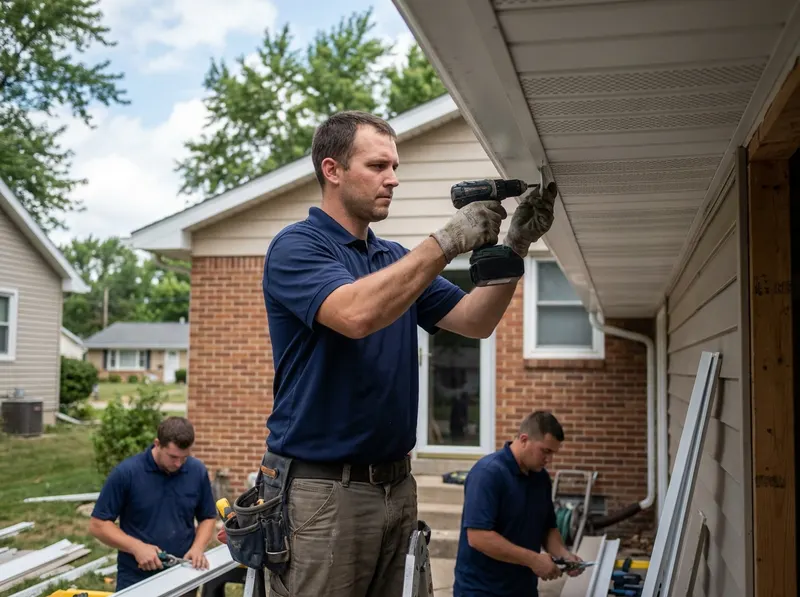
- Included: removal of existing soffit and trim, substrate moisture inspection, installation of new vented or solid soffit panels and fascia wrap or board, caulking and sealing at all joints and corners.
- Timeline: most single-family homes in Peoria, a 1,500, 2,200 sq ft ranch or two-story, are completed in 1 to 3 days depending on linear footage of trim and number of roofline returns.
- Ballpark cost: $1,800, $6,500 for a full trim-and-soffit replacement on a typical Peoria home; exact price confirmed on a free on-site visit because substrate condition, material choice, and linear footage vary house to house.
- What gets removed: deteriorated aluminum or wood soffit panels, rotted or painted-over fascia boards, cracked corner trim, and J-channel that has pulled away from the wall, all hauled from the site.
- How to book: call (309) 555-0147 or text a photo of the affected roofline for a preliminary assessment; a named project lead schedules the on-site inspection within 48 hours.
Peoria County's climate puts trim and soffit under stress that most homeowners only notice after the damage is already deep. Winter temperatures regularly drop below 10 °F, and the freeze-thaw cycle that runs from November through March forces moisture into any gap between the fascia board and the roof deck. By the time a homeowner in Richwoods or Prospect Heights sees paint peeling on the fascia or a wasp nest tucked into a delaminating soffit panel, the rafter tails behind that panel have often been absorbing water for two or more seasons. The first step in every Sealwell Siding Services trim-and-soffit job is a substrate inspection, probing the rafter tails and top plate for soft spots, before a single panel is ordered, because replacing soffit over a rotted tail is a repair that fails within three to five years.
The installation sequence runs in four stages. First, the old soffit and fascia are removed and the cavity is photographed so the homeowner can see the actual condition of the framing. Second, any rotten wood is replaced, typically with pressure-treated lumber rated for ground-contact or above-ground exposure per American Wood Council guidelines. Third, new soffit panels, vented at a ratio of 1 sq ft of net free area per 150 sq ft of attic floor, per the IRC Section R806, are snapped into place. Fourth, fascia wrap or cellular PVC board is installed, caulked at every miter and butt joint with a paintable polyurethane sealant, and inspected for flush alignment before the crew leaves. Homes in Glen Hollow and North Valley, many built in the 1970s and 1980s with original wood soffits, often require the full four-stage process; homes in newer sections of Kellar Heights or Springdale with aluminum soffit from the 1990s may need panel replacement only, which shortens the job to one day.
Material choice changes both the price and the maintenance picture. Aluminum soffit and fascia wrap, the most common material on Peoria homes built between 1975 and 2000, runs roughly $3, $6 per linear foot installed and resists the mold growth that wood soffits develop in humid Illinois summers. Cellular PVC trim board costs $5, $10 per linear foot installed, holds paint longer, and is dimensionally stable across the temperature swings recorded at the NWS Lincoln, IL office, useful on south- and west-facing elevations in Alta Terrace and Lakeview that get direct afternoon sun. Fiber cement trim runs $6, $11 per linear foot installed and is the right call when the adjacent siding is already fiber cement, because mismatched expansion rates create gaps over time. If the existing trim is aluminum and structurally sound at the nail flange, a VSI-compliant aluminum wrap over the existing fascia board is sometimes sufficient, a one-day job at the lower end of the cost range. The on-site inspection determines which path applies; there is no way to confirm it from a photo alone.
Homes near the Heading Hills and Sheridan Village corridors, where mature oaks and maples overhang rooflines, tend to show accelerated soffit deterioration because leaf debris traps moisture against the fascia for weeks at a time. In those situations, vented soffit with a HUD-recommended minimum 1-inch air gap between the top of the soffit channel and the roof deck helps the cavity dry between rain events. Sealwell Siding Services documents the vent-to-attic-floor ratio on every job and leaves the homeowner with a written record of what was installed, useful when the house is sold and a buyer's inspector asks about attic ventilation compliance. That written record is part of the standard job closeout, not an add-on.
Trim and Soffit Replacement cost in Peoria
Every job gets a firm, written price after a free on-site visit.
Common questions
How do I know if my soffit needs full replacement or just repair in Peoria?
What soffit ventilation ratio is required for Peoria homes under Illinois building code?
Does trim and soffit replacement in Peoria require a building permit?
How long does new aluminum or vinyl soffit last on a Peoria home?
Can trim and soffit replacement be done at the same time as a full siding job in Peoria?
For standards, safe disposal, and service guidance on Siding Services in Peoria, IL, useful references include U.S. Dept. of Energy, ENERGY STAR, HUD, OSHA, U.S. Green Building Council, and Google Maps. General consumer and small-business resources are available from USA.gov, Better Business Bureau, FTC Consumer Advice, U.S. Small Business Administration, and Ready.gov.
Get started today
Tell us about your trim and soffit replacement job in Peoria and we'll send a clear, written quote, usually the same day.